Stay connected
Learn about the latest research and results from the project.
Subscribe to the NATURANCE Newsletter!
Listen to our podcast “NATURANCE Talks“
Learn about the latest research and results from the project.
Subscribe to the NATURANCE Newsletter!
A common framework that helps determine when ecosystem restoration and protection measures are sufficiently material to support underwriting, investment, and financing decisions
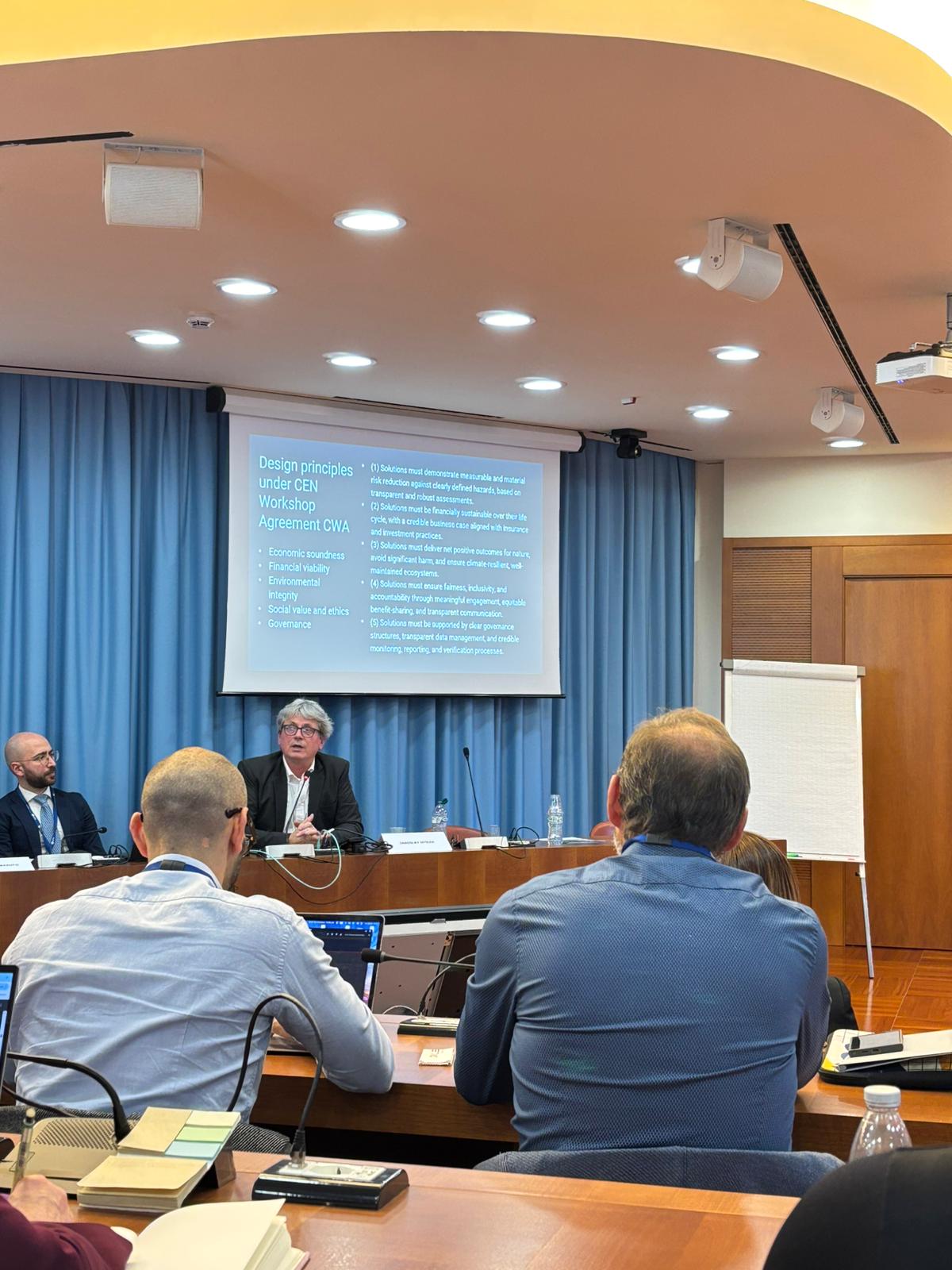
The CEN Workshop Agreement “Nature-based insurance and investments – Guidance on performance and design criteria” (CWA 18349:2026) establishes a common reference framework for insurance and investment solutions based on the natural environment, integrating ecosystem protection and restoration with financial instruments for climate risk management. The results incorporated into the CWA build upon the outcomes of the NATURANCE project, whose objectives are directly aligned with those of the Workshop proposal. The Secretariat of the Workshop process was provided by UNI – Italian Standards Body.
The document places particular emphasis on Disaster Risk Reduction (DRR) through the sustainable management of ecosystems – an area of significant relevance for insurers and investors – and sets out minimum requirements in terms of economic and financial soundness, environmental integrity, social value, ethical practices, and inclusive governance.
Its objective is to support the wider adoption of risk financing mechanisms by promoting nature-based solutions that are effective in addressing extreme climate events, while contributing to the maintenance and restoration of ecosystems that are essential for community well-being and resilience.
The CWA guiding principles do not duplicate existing standards; instead, they extend and complement them. They establish a common foundation and a level playing field for assessing nature-based insurance and investment solutions designed to reduce climate disaster risk. In doing so, they define what constitutes a robust and credible solution, identify the evidence required to support it, and describe the processes that underpin its design, implementation, and evaluation, supporting the development of the proposed solutions.
Shared metrics translate the guiding principles into measurable evidence that can be assessed, compared, and used to monitor performance, quality, and change over time. They provide a consistent and transparent basis for evaluating whether a nature-based insurance and investment solution is material to risk, delivers its intended outcomes, and generates value across different contexts and time horizons. By enabling comparability and accountability, shared metrics support informed decision-making and strengthen confidence in the effectiveness of such solutions.
Practical case studies illustrate how the framework can be applied in practice. The examples address real environmental risks, such as wildfires and floods, highlighting the operational potential of the proposed approach.

Economic soundness explains whether a solution “makes sense” within the broader social welfare system. It is not limited to the perspective of investors or insurers but considers the value of the solution to “society as a whole”. It assesses whether the solution is worth implementing once all site-specific and wider private and public benefits are taken into account.
Financial viability provides a detailed overview of a solution’s financial structure, including how it is funded, operated, and sustained over time. It presents a comprehensive breakdown of the costs associated with implementing the project, including the nature-based intervention itself, and explains how these costs are recovered or repaid. It also identifies additional costs that may arise throughout the solution’s lifetime, such as those related to operation, maintenance, monitoring, and end-of-life or decommissioning activities, as well as the measures in place to manage financial and operational risks and related contingencies.
Evidence of environmental integrity should demonstrate that each solution contributes to positive ecological gains (such as improved habitat quality, increased biodiversity, enhanced ecosystem connectivity) within a larger landscape or catchment context and avoids harm.
Social value and ethical practice metrics substantiate the guiding principle of fairness and inclusion, through status indicators that show whether the minimum conditions for equitable and ethical implementation have been met.
Governance, data, and assurance metrics examine the processes through which solutions are designed, managed, and supported by evidence, rather than their performance outcomes. For that reason, they focus on the credibility, traceability, and consistency of results, assessing whether these processes are managed in a transparent, accountable, and verifiable manner throughout the entire life cycle of the solution.