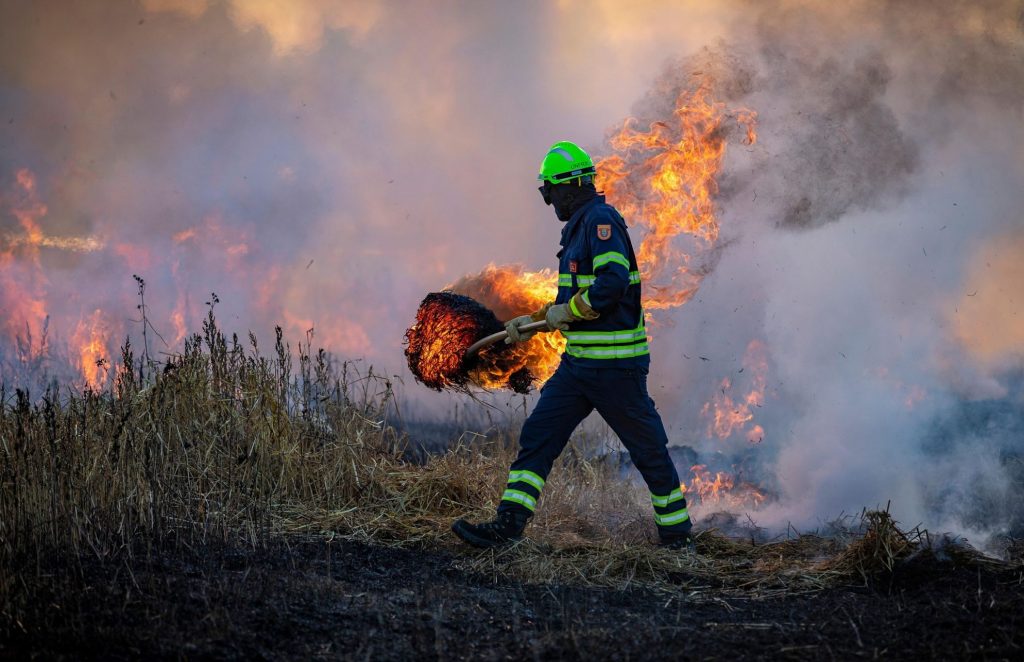
As wildfires become more frequent and destructive across Europe and beyond, driven by climate change, land-use dynamics and expanding urban interfaces, the limits of a suppression-only approach are increasingly evident. This INSIDERS Lunch Break Seminar, organised by IIASA within the NATURANCE project, explored how the insurance sector can help shift wildfire risk management from reactive response to proactive prevention through nature-based solutions (NbS).
The session brought together expertise from climate risk modelling, ecology and finance to address four core questions: how wildfire risks are evolving, how insurance models are adapting, which NbS can effectively reduce wildfire risk, and how insurers can support their implementation through underwriting and investment strategies.
Evolving wildfire risk and insurance challenges
Opening the discussion, Daniel Bannister (WTW) highlighted how wildfire losses are increasingly driven not simply by more fires, but by extreme events intersecting with human exposure, particularly in the wildland–urban interface. Recent fire seasons have shown that catastrophic losses can arise even from relatively limited fire footprints when they affect dense, high-value urban areas. Bannister emphasised that traditional wildfire catastrophe models – largely calibrated on historical conditions – struggle to capture these extremes, urban fire dynamics and ember-driven spread. While newer models are beginning to incorporate climate change, fuel dynamics and urban escalation, he stressed that collaboration across science, insurance and policy is essential to understand where models remain fragile and how risk is truly changing.
Nature-based solutions for fire-resilient landscapes
Saskia Kistra (Climate-KIC / Wageningen University) then unpacked what nature-based solutions mean in practice for wildfire risk reduction. NbS range from adaptive forestry, agroforestry and rewetting measures that reduce fuel loads and fire intensity, to post-fire interventions that limit erosion, flooding and ecosystem degradation. A key message was that fire is a natural process, but changing climate and land-use patterns are increasing its frequency, intensity and impacts. Rather than aiming to eliminate fire, NbS support a transition from fire suppression to fire management, promoting landscapes that can burn in smaller, less destructive and more manageable ways. Kistra also stressed that NbS must be tailored to local biophysical and governance contexts, and that their co-benefits for biodiversity, soil health and climate adaptation are central to their long-term value.
How insurers can enable NbS
Closing the speaker session, Timothy Foreman (IIASA / Vienna University of Economics and Business) examined how insurance frameworks can actively incentivise wildfire risk reduction. Drawing on examples from California, he showed how regulatory measures already require insurers to recognise community-level risk mitigation actions, such as Firewise programmes, through premium reductions. While these schemes do not yet explicitly target NbS, they provide a clear blueprint for integrating landscape-scale prevention measures into insurance pricing and risk assessment. Foreman also highlighted rare but promising cases where insurers have directly accounted for forest fuel reduction in premium calculations, demonstrating that NbS can be recognised as loss-reducing assets when appropriate data, governance and coordination are in place.
Key takeaways
Across the discussion, a shared conclusion emerged: investments in wildfire prevention continue to lag far behind spending on suppression, despite strong evidence that prevention can reduce long-term risk and losses. Financing remains a critical barrier, as NbS require stable, long-term funding and cooperation between insurers, policymakers, scientists and local communities. Integrating NbS into insurance frameworks offers a powerful lever to overcome this gap, aligning risk reduction, financial resilience and environmental benefits.
By showcasing emerging approaches and real-world examples, the seminar underscored the evolving role of insurers, not only as risk carriers, but as enablers of healthier, safer and more resilient landscapes in a warming world.