
Article by Neil Gunn, Head of Flood and Water Management Research at Willis Research Network Team
Extreme heat is now one of the most consequential risks facing cities. Rising background temperatures, combined with urban characteristics, mean heat events occur more often, last longer and affect larger populations. Unlike floods, heat leaves no obvious physical footprint and can occur anywhere. Its impacts build through stress on people, infrastructure and services, often only becoming visible once systems are already under strain.
This makes extreme heat not just a climate hazard, but a coordination challenge, where human vulnerability, infrastructure performance and access to timely funding determine outcomes.
Between 2000 and 2019, approximately 489,000 heat related deaths occurred annually, with 45% in Asia and 36% in Europe. An estimated 61,672 heat related excess deaths occurred across Europe in summer 2022 alone.[1] Cities are particularly exposed: dense development, limited vegetation and large areas of hard surface absorb heat by day and release it slowly at night, creating persistent urban heat islands. Heatwaves can therefore become multi day events with little night time recovery, increasing health risks and pressure on energy, transport and emergency services.
The UK heatwave of summer 2022 illustrates this shift. In London, temperatures exceeded 40°C for the first time on record. Rail services were suspended as tracks overheated, roads deteriorated, power demand surged and health services reported sharp increases in heat related illness. Transport for London estimated they lost £8.9 million in one week.[2] The event showed how even a short period of extreme heat can disrupt systems not designed for such conditions.
Anatomy of a heat wave
Several features determine the severity of a heat event. Absolute temperature remains important, but it is not sufficient on its own. Overnight temperatures matter because sustained warm nights prevent the body’s natural cooling systems from losing heat. Duration matters because impacts accumulate over successive days. Together, these factors define whether a hot spell remains uncomfortable or becomes hazardous.
Heat is often perceived as subjective, but its impacts are not random. Risk depends not only on ambient conditions, but on how people experience heat in daily environments. Age is a critical factor; older people and very young children are less able to regulate body temperature. Pre-existing health conditions further increase risk.
Occupation also matters. Outdoor workers, transport staff and those in non-air-conditioned environments are exposed for long periods during the hottest parts of the day. Heat can impair concentration, increase accident risk and reduce productivity long before clinical illness appears.
Building type strongly shapes exposure. Modern buildings designed to retain heat perform poorly during heatwaves, particularly where ventilation is limited or building aspect increases solar gain. High rise housing can trap warm air, while poorly insulated low-rise buildings may overheat rapidly. The same temperature can therefore have different consequences depending on where and how people live and work. In this sense, heat risk is less defined by the event itself and more by the characteristics of the population exposed to it. The same conditions can produce very different outcomes depending on vulnerability, access to cooling and the ability to adapt.
City strategies to combat heat are essential. These variations mean heat impacts cannot be captured by a single metric. Thresholds based solely on daytime maximum temperature fail to reflect who is affected and when. Measures that also consider humidity, nighttime temperature and duration better reflect lived experience and the conditions under which harm occurs.
Too Hot to handle
Climate change is altering the frequency and character of heat events. Rare extremes are becoming more common, while typical summer conditions are shifting upward. Cities now face longer periods of sustained warmth punctuated by extreme peaks.
Most cities remain under prepared: buildings and infrastructure are not designed for the reality of climate change. While many have broad climate strategies, fewer have dedicated plans focused on heat. A heat health plan sets out how a city prepares for, responds to and recovers from extreme heat, linking meteorological thresholds to actions across health services, social care, infrastructure operators and emergency responders.
Coverage and maturity vary widely. Where plans do exist, they often focus on public health messaging and short-term response rather than long term risk reduction. As heat becomes a routine stressor rather than an exception, the gap between policy and operational readiness widens. It reflects competing priorities, constrained budgets and fragmented responsibilities, all of which make it difficult to translate long-term strategy into timely, coordinated action.
City managers sit at the centre of heat risk management, even where formal responsibility is fragmented. Their role is to translate climate information into operational decisions, balancing competing demands across services, budgets and political priorities.
This includes identifying who is most exposed, coordinating across agencies, ensuring critical services can operate under heat stress and planning interventions before thresholds are crossed. Unlike flood risk, heat does not concentrate responsibility within a single department, so effective management depends on coordination rather than control.
City managers must also operate under uncertainty. Heat impacts are diffuse, data may be imperfect and many consequences emerge only after an event. This makes proactive investment difficult, even where risks are understood.
The long game
It will take time and money to make existing buildings and infrastructure more resilient to todays and future climates. However, Nature-based Solutions (NbS) offer a potentially swift set of effective tools for reducing urban heat. Trees, parks, green roofs and water bodies cool cities through shading and evapotranspiration, lowering surface and air temperatures and reducing nighttime heat retention. Temperature reductions can be measured at macro, neighbourhood or building scale. For example, in the UK, green facades have been shown to reduce internal building temperature by 5.7˚C.[3]
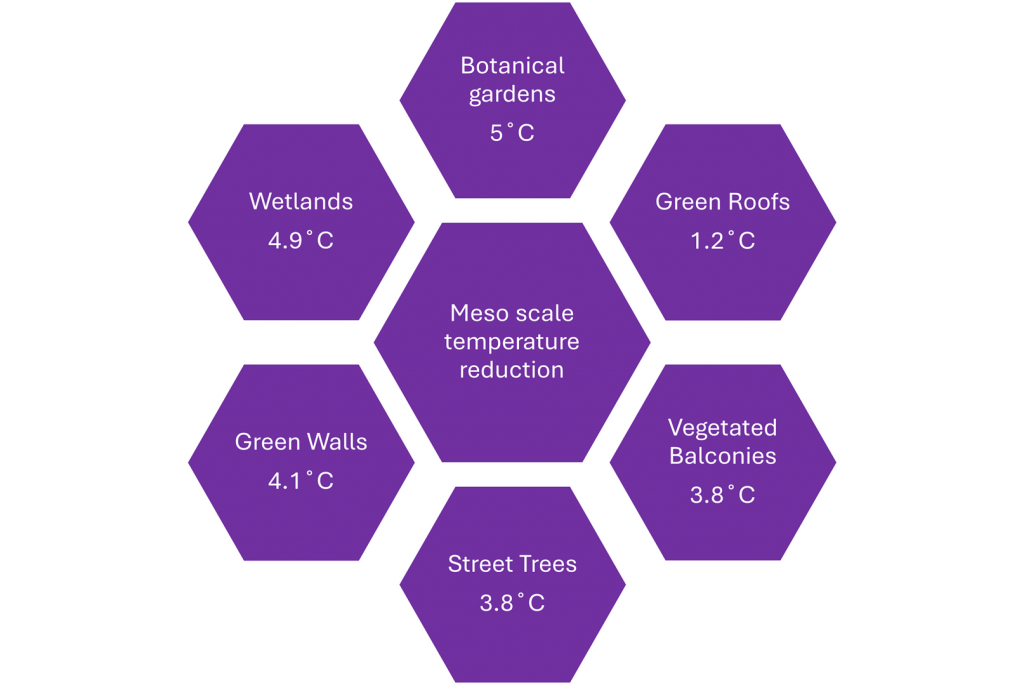
These measures provide multiple benefits beyond cooling, supporting air quality, biodiversity and flood management, while improving wellbeing. However, performance is not guaranteed: extreme heat and water scarcity can stress vegetation, reducing effectiveness when cooling is most needed. As with any infrastructure, NbS must be treated as assets requiring design, maintenance and protection. Cooling benefits should be considered alongside resilience to heat and drought.
Nature for Insurance
Insurance has historically played a limited role in heat risk because losses are less likely to be physical and are difficult to attribute. However, insurance can support preparedness and response by providing predictable funding when extreme conditions occur.
To understand how NbS can support insurance, the NATURANCE project found that index based (parametric) insurance could support heat risk management. By linking predefined heat conditions to rapid payouts, it can fund actions such as outreach to vulnerable populations, temporary cooling measures and reinforcement of critical services. However, because vulnerability varies between groups and across locations, it is hard to tie a single temperature threshold to the full range of citywide impacts. The study warned that policy designers should assess impacts comprehensively and coordinate with infrastructure and service providers; pooled data can help quantify and aggregate losses.
Insurance does not replace adaptation; it can complement it by addressing funding gaps during extreme events. For city managers, the value lies less in compensation after loss and more in enabling timely action that reduces harm.
Five actions city managers can take
- Understand local heat risk by identifying who is exposed, where and under what conditions. This may involve installation of instrumentation and extensive data collection;
- Integrate heat into emergency planning alongside better established hazards;
- Design and protect Nature-based Solutions as core infrastructure;
- Ensure buildings and services can operate under higher temperatures;
- Explore financial tools, including insurance, that provide liquidity when thresholds are exceeded.
References
[1] United Nations Office for Disaster Risk Reduction. Global Assessment Report on Disaster Risk Reduction. (2025)
[2] TFL Annual report and statement of accounts 2022/2023
[3] Thomsit-Ireland, F. – The impact of green facades and vegetative cover on the temperature and relative humidity within model buildings (2020)
[4] Kumar P. et al. – Urban heat mitigation by green and blue infrastructure; Drivers, effectiveness and, future needs (2024)