
From Ecuador to Fiji, from Sri Lanka to France, nature-related insurance products are reshaping the way communities interact with nature and financial resilience amid rapidly evolving climate conditions. To capture this momentum and inform insurance innovation, the newly launched NATURANCE Compendium takes stock of best practices from across the globe and within the project’s scope, serving as a comprehensive reference for policymakers, investors, practitioners and researchers.
The NATURANCE consortium has recently published its flagship collection of literature and case studies from the insurance, conservation and policy sector, consolidating the project outputs alongside worldwide experiences, as drawn from original research and the work of organisations including UNEP FI and the Ocean Risk and Resilience Action Alliance (ORRAA).
The Compendium includes an in-depth analysis of 21 nature-related insurance products, drawn from over 45 case studies, available through a dedicated webpage on the NATURANCE website, alongside a consistent body of literature and guidance, hosted in the NATURANCE Digital Library. Altogether, these resources are intended to inspire all those interested in moving from risk awareness to nature-based solution implementation.
Literature and guidance
The Compendium showcases the work of the NATURANCE project through its several deliverables and the activity of its nine innovation labs, which brought together local stakeholders to co-design practical solutions for specific hazards and policy contexts. The project’s literature is complemented by external guidance from a range of high-level sources, including the United Nations Environment Programme Finance Initiative (UNEP FI), United Nations Development Programme (UNDP), World Wide Fund for Nature (WWF), and The Geneva Association. The analysis highlights two key gaps yet to be filled: insurance in this space still compensates more than it prevents, and nature-related risks remain largely unaccounted for in risk modelling. Building on a growing body of good practices is therefore essential to mainstreaming nature’s risk-reduction benefits. To mainstream nature’s risk-reduction benefits and close these gaps, it is essential to document and promote best practices.
Case Studies
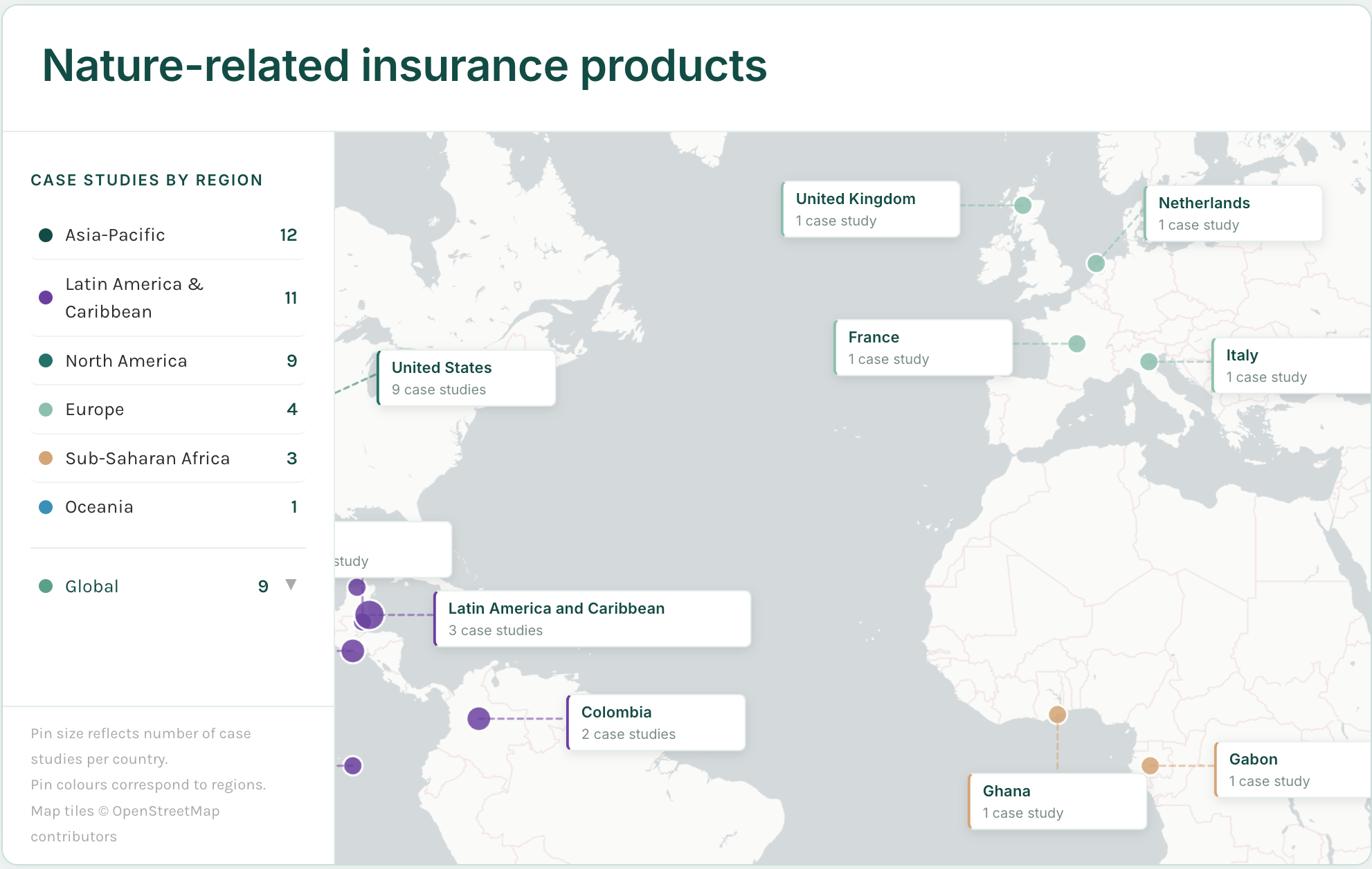
At its core, the Compendium highlights 45 case studies covering all continents, spanning a wide variety of risk types and insurance approaches from indemnity to parametric. The evidence base reflects a broad global picture. Emerging markets – across Asia-Pacific, Latin America and the Caribbean – account for 46% of the case studies, underscoring that innovation in this space is far from confined to wealthy nations. Among the risks covered, the majority address direct risks to nature, yet transition risk insurance, covering liabilities linked to integrating nature into risk management, accounts for just 6% of cases. The message is clear: the market is expanding, but some of its most promising frontiers still hold significant room for growth.
To discover additional trends and insights on the NATURANCE stocktaking effort, discover all the digital resources available.